











Complexity starts before migration
The hardest issues are usually discovered through disciplined discovery — not during the final weeks of a cutover plan.
ACC CloudMove for Epicor
A practical, low-risk framework for helping Epicor customers assess, prepare, migrate, and stabilize with greater control.
Epicor SaaS transition is rarely a single technical event. For most organizations, risk accumulates quietly in undiscovered dependencies, unclear customization ownership, reporting assumptions buried in spreadsheets, and operational routines that evolved around an on-premises reality. When execution pressure arrives, those gaps become expensive because decisions are forced late — under fixed timelines and with limited room to negotiate scope.
Waiting does not simplify the problem; it often hardens it. Master data drift continues, integrations keep changing, and tribal knowledge walks out the door. A structured path exists to surface complexity early, protect continuity in finance and supply chain, and give leadership a controlled sequence rather than a surprise cascade at go-live.
The hardest issues are usually discovered through disciplined discovery — not during the final weeks of a cutover plan.
Unresolved data, customization, and integration questions do not disappear; they reappear as rework, delays, and operational exposure.
Success requires aligned decisions across IT, operations, and finance, with explicit control over scope, timing, and operational readiness.
A roadmap with clear phases helps leadership choose pace, phasing, and investment with evidence — not assumptions.
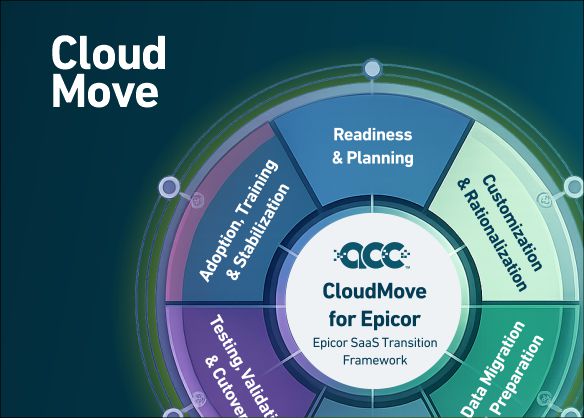
Explore the six core modules of the CloudMove framework. On desktop, use the module list or the hotspots on your architecture chart; on mobile, expand each module for the same detail.

Interactive hotspots correspond to the six CloudMove modules. Adjust hotspot coordinates in the page script if your diagram layout differs.
Define scope, assess complexity, and build the migration roadmap.
Define scope, assess complexity, and build the migration roadmap.
Evaluate what to retain, redesign, replace, or retire.
Clean, map, validate, and prepare data for migration.
Align interfaces, reports, extensions, and dependencies.
Control go-live risk through structured testing and cutover planning.
Enable users, support transition, and stabilize operations post go-live.
Maintain alignment, scope discipline, and project control throughout the migration journey.
Protect finance, reporting, and supply chain operations during transition.
Preserve control over roles, access, auditability, and compliance requirements.
Support user readiness, communication, and internal coordination across the transition.
Each phase is designed to reduce ambiguity, protect operational reality, and keep leadership in control as the organization moves toward Epicor SaaS.
Building the right foundation before migration begins
Epicor SaaS migration should not begin with execution alone. In many organizations, the real complexity lies across existing processes, customizations, integrations, reporting needs, and operational dependencies. If these areas are not assessed early, risks often surface too late—when timelines become compressed and decisions more difficult.
ACC CloudMove for Epicor starts with a structured readiness and planning phase that helps organizations assess the current environment, define the right scope, identify key risks, and establish a practical roadmap. This creates stronger alignment, clearer priorities, and better control before the migration moves forward.
Reducing legacy complexity before it becomes a migration obstacle
In many Epicor environments, years of customizations, process workarounds, and local variations gradually become part of daily operations. While some of these changes remain business-critical, others add complexity without delivering long-term value. If they are carried forward without review, migration scope expands, testing becomes heavier, and future maintainability becomes harder to sustain.
ACC CloudMove for Epicor addresses this through a structured customization and rationalization phase that helps organizations evaluate what should be retained, redesigned, replaced, or retired. This creates a more practical future-state model—one that reduces unnecessary complexity while preserving the capabilities the business genuinely depends on.
Preparing reliable data for a more controlled transition
Data readiness is one of the most critical factors in a successful Epicor SaaS migration. In many organizations, data issues do not appear as a single problem, but as a combination of inconsistent master data, duplicated records, incomplete fields, outdated structures, and reporting dependencies built over time. If these are not addressed early, they can affect migration accuracy, user confidence, and post-go-live stability.
ACC CloudMove for Epicor includes a structured data migration and preparation phase that helps organizations review data quality, define migration rules, validate key data sets, and prepare for a more controlled transition. The objective is not only to move data, but to move it with the accuracy, consistency, and discipline required to support business continuity in the new SaaS environment.
Protecting critical business connections across the migration journey
Epicor environments rarely operate in isolation. Over time, many organizations build important dependencies across interfaces, reports, extensions, third-party applications, shop floor tools, and surrounding business systems. These connections often support day-to-day execution, visibility, and decision-making, but they can also become hidden points of risk if not reviewed early in a SaaS migration.
ACC CloudMove for Epicor includes a structured integration and extension strategy phase that helps organizations identify critical dependencies, assess future-state fit, and define how these connections should evolve in the SaaS environment. This reduces the risk of disruption, avoids overlooked technical gaps, and supports a more stable transition across business-critical processes.
Reducing go-live risk through structured readiness and execution
A migration plan is only as strong as its ability to hold up under testing and real operational conditions. In Epicor SaaS migration, risk often concentrates in the final stages—when business processes, data, integrations, reporting, and user readiness must all work together under time pressure. Without structured validation and cutover discipline, issues that appear manageable in design can become disruptive at go-live.
ACC CloudMove for Epicor includes a dedicated testing, validation, and cutover phase to help organizations confirm readiness before transition takes place. By structuring testing cycles, validating critical business scenarios, rehearsing cutover activities, and coordinating go-live control, this phase helps reduce avoidable disruption and strengthens confidence across both project teams and business stakeholders.
Helping users transition with confidence while stabilizing operations after go-live
A technically successful migration does not guarantee a successful business transition. In practice, many post-go-live issues are not caused by the system alone, but by gaps in user readiness, training effectiveness, process understanding, and early operational support. If these areas are underestimated, organizations may face slower adoption, inconsistent execution, and reduced confidence in the new SaaS environment.
ACC CloudMove for Epicor includes a focused adoption, training, and stabilization phase to help organizations support users through transition and strengthen operational control after go-live. By preparing users, reinforcing process understanding, providing structured hypercare, and addressing early-stage issues quickly, this phase helps the business move from implementation into stable day-to-day use with greater confidence.
These are the problems leadership teams feel — even when the project plan looks orderly on paper.
Years of tailored logic embed undocumented assumptions. Carrying everything forward inflates scope; cutting without analysis creates operational exposure. The hard work is deciding what the business truly needs in SaaS — not simply replicating the past.
Interfaces, EDI, plant systems, and extensions rarely have a single authoritative map. Failures often appear as missed transactions, broken operational loops, or silent reporting drift — late, when pressure is highest.
Master data drift, duplicates, and legacy structures compound quietly until migration rules force reconciliation. The outcome is not “a data task” — it is confidence in inventory, costing, and financial truth at cutover.
Critical visibility often depends on legacy joins, local extracts, and tribal report logic. SaaS requires deliberate redesign so leaders do not lose decision-quality information at the moment accountability peaks.
Go-live success is defined by execution quality in real processes — not training attendance. Weak role readiness and unclear ownership produce variance, rework, and shadow workflows that undermine the investment.
Finance, operations, and IT must share the same scope and timing reality. Misalignment shows up as late surprises, compressed testing, and avoidable operational risk — especially in international and multi-entity environments.
ACC is positioned as an Epicor-focused partner — not a generalist integrator applying a template from unrelated platforms. CloudMove reflects how serious Epicor customers actually move: with operational continuity as a constraint, adoption as an outcome, and scope discipline as a leadership tool.
CloudMove is intentionally modular so teams can see where risk lives — readiness, rationalization, data, integrations, validation, adoption — and govern each lane with clear accountability. The objective is predictable control, not narrative confidence.
ACC approaches migration with an explicit understanding that ERP supports month-end, supply continuity, shop execution, and compliance. That lens changes prioritization: what must never break, what can wait, and what must be rehearsed.
International organizations face phasing complexity, localization realities, and coordination across time zones. CloudMove is communicated as a leadership-ready framework so regional teams can align without losing a single coherent standard.
ACC’s role is to reduce ambiguity with evidence — assessments, decisions, and validated readiness — so executives can sponsor the transition with clear milestones and defensible go / no-go criteria.
Practical answers to the questions organizations typically need to resolve before moving from on-premises to Epicor SaaS.
Every Epicor SaaS transition raises important questions around risk, continuity, customization, data, integrations, user adoption, and timing. The goal is not to ignore those concerns, but to address them early with clearer structure and better decisions.
Many Epicor environments include years of customizations, local workarounds, and business-specific logic. A successful SaaS transition should not assume that everything must be carried forward unchanged. The practical approach is to classify each customization into four categories: retain, redesign, replace, or retire. This helps reduce unnecessary complexity while protecting the capabilities the business still depends on. The goal is not to remove customization for its own sake, but to avoid taking avoidable technical debt into the future-state SaaS environment.
Start with readiness, not assumptions.