
The First Epicor Partner in Asia
As the first Epicor partner in Asia, ACC has worked with Epicor since its early expansion in the region, building deep experience across different Epicor generations, industries, and deployment models.
Plan your Epicor SaaS migration with greater clarity, control, and confidence — from readiness assessment and customization review to data preparation, integration strategy, testing, cutover, and user adoption.
For many Epicor users, moving to SaaS is not just a technical upgrade. It requires careful planning across processes, customizations, integrations, data, reporting, testing, user readiness, and operational continuity. ACC CloudMove for Epicor helps organizations approach this transition with a structured framework and experienced Epicor guidance.
FAQ
Practical answers to the questions organizations typically need to resolve before moving from on-premises to Epicor SaaS.
Every Epicor SaaS transition raises important questions around risk, continuity, customization, data, integrations, user adoption, and timing. The goal is not to ignore those concerns, but to address them early with clearer structure and better decisions.
Many Epicor environments include years of customizations, local workarounds, and business-specific logic. A successful SaaS transition should not assume that everything must be carried forward unchanged. The practical approach is to classify each customization into four categories: retain, redesign, replace, or retire. This helps reduce unnecessary complexity while protecting the capabilities the business still depends on. The goal is not to remove customization for its own sake, but to avoid taking avoidable technical debt into the future-state SaaS environment.
Why ACC
ACC is not a general IT vendor entering the Epicor market. We are an experienced Epicor partner with over 20 years of hands-on project delivery, deep manufacturing knowledge, and a proven track record supporting Epicor users across Asia and international markets.
As the first Epicor partner in Asia, ACC has worked with Epicor since its early expansion in the region, building deep experience across different Epicor generations, industries, and deployment models.
With more than two decades of Epicor consulting experience, ACC understands not only the system, but also the operational realities behind manufacturing, finance, supply chain, warehouse, and reporting processes.
ACC has supported hundreds of Epicor-related projects across implementation, enhancement, integration, reporting, customization, and operational improvement — helping clients turn ERP into real business value.
ACC supports international Epicor users across the Americas, Europe, and Asia, combining deep Epicor experience with a practical delivery approach for multi-site, multi-region, and cross-border ERP environments.
Framework
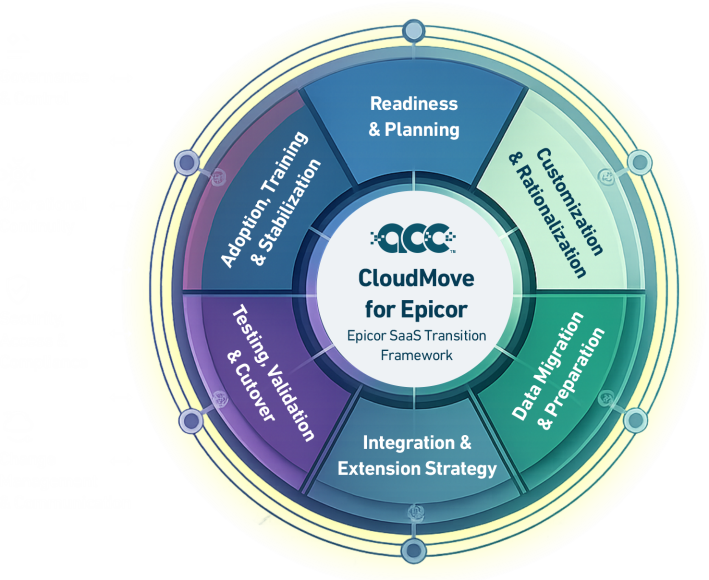
A practical migration framework designed to help Epicor users move from assessment to adoption with stronger control.
Optional overview diagram — replace with your chart when ready.

Building the right foundation before migration begins
Epicor SaaS migration should not begin with execution alone. In many organizations, the real complexity lies across existing processes, customizations, integrations, reporting needs, and operational dependencies. If these areas are not assessed early, risks often surface too late — when timelines become compressed and decisions become more difficult.
ACC CloudMove for Epicor starts with a structured readiness and planning phase that helps organizations assess the current environment, define the right scope, identify key risks, and establish a practical roadmap.
A controlled migration begins with readiness, not assumptions.Back to ACC CloudMove Framework ↑
Reducing legacy complexity before it becomes a migration obstacle
In many Epicor environments, years of customizations, process workarounds, and local variations gradually become part of daily operations. While some of these changes remain business-critical, others add complexity without delivering long-term value. If they are carried forward without review, migration scope expands, testing becomes heavier, and future maintainability becomes harder to sustain.
ACC CloudMove for Epicor helps organizations evaluate what should be retained, redesigned, replaced, or retired — creating a more practical future-state model while preserving the capabilities the business genuinely depends on.
The goal is not to move every customization forward. It is to carry forward what the business truly needs.Back to ACC CloudMove Framework ↑
Preparing reliable data for a more controlled transition
Data readiness is one of the most critical factors in a successful Epicor SaaS migration. In many organizations, data issues do not appear as a single problem, but as a combination of inconsistent master data, duplicate records, incomplete fields, outdated structures, and reporting dependencies built over time. If these are not addressed early, they can affect migration accuracy, user confidence, and post-go-live stability.
ACC CloudMove for Epicor includes a structured data migration and preparation phase to help organizations review data quality, define migration rules, validate key data sets, and prepare for a more controlled transition.
Successful migration is not only about moving data. It is about moving data the business can trust.Back to ACC CloudMove Framework ↑
Protecting critical business connections across the migration journey
Epicor environments rarely operate in isolation. Over time, many organizations build important dependencies across interfaces, reports, extensions, third-party applications, shop floor tools, and surrounding business systems. These connections often support day-to-day execution, visibility, and decision-making — but they can also become hidden points of risk if not reviewed early in a SaaS migration.
ACC CloudMove for Epicor helps organizations identify critical dependencies, assess future-state fit, and define how these connections should evolve in the SaaS environment.
Migration risk often sits at the edges of the system — where integrations, extensions, and business dependencies are easiest to overlook.Back to ACC CloudMove Framework ↑
Reducing go-live risk through structured readiness and execution
A migration plan is only as strong as its ability to hold up under testing and real operational conditions. In Epicor SaaS migration, risk often concentrates in the final stages — when business processes, data, integrations, reporting, and user readiness must all work together under time pressure. Without structured validation and cutover discipline, issues that appear manageable in design can become disruptive at go-live.
ACC CloudMove for Epicor includes a dedicated testing, validation, and cutover phase to help organizations confirm readiness before transition takes place.
Testing is where migration plans are proven — and where unmanaged assumptions are most likely to be exposed.Back to ACC CloudMove Framework ↑
Helping users transition with confidence while stabilizing operations after go-live
A technically successful migration does not guarantee a successful business transition. In practice, many post-go-live issues are not caused by the system alone, but by gaps in user readiness, training effectiveness, process understanding, and early operational support. If these areas are underestimated, organizations may face slower adoption, inconsistent execution, and reduced confidence in the new SaaS environment.
ACC CloudMove for Epicor includes a focused adoption, training, and stabilization phase to help organizations support users through transition and strengthen operational control after go-live.
Go-live is not the end of the migration. It is the point where user confidence, operational stability, and long-term value begin to take shape.Back to ACC CloudMove Framework ↑
Strategic context
Many Epicor users are now reviewing their future ERP roadmap as the market continues moving toward cloud-based ERP deployment. For organizations running older or highly customized Epicor environments, the key question is no longer only whether to move to SaaS — but how to move in a controlled, practical, and lower-risk way.
Migration affects business processes, user roles, data structures, integrations, reports, and operating discipline.
Years of customizations, local workarounds, reporting logic, and third-party dependencies can create risk if they are not reviewed early.
A clear roadmap helps leadership, IT, operations, finance, and key users understand what should be retained, redesigned, replaced, or retired.
Practical overview of the ACC CloudMove framework for Epicor users planning on-premise to SaaS migration.
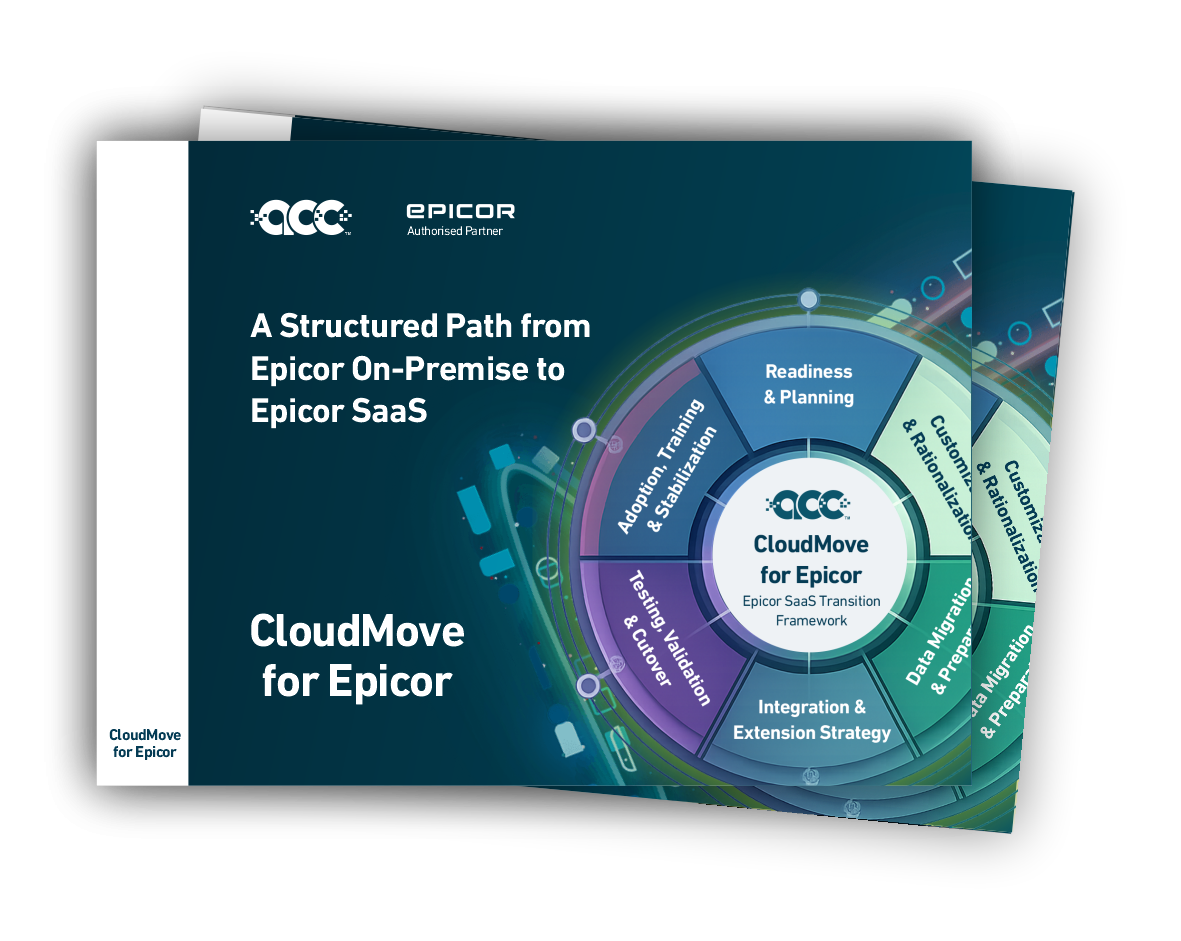
Enter your name, work email, and company details to access the brochure and receive relevant follow-up communications from ACC.
Contact
Talk to ACC about how CloudMove can help your team assess readiness, reduce migration risk, and build a practical roadmap for your Epicor SaaS transition.


