Rising Maintenance Cost
Annual support and maintenance fees continue to increase while business value becomes harder to justify.
In today’s economic environment, many printing and packaging manufacturers are under pressure to reduce cost, improve agility and gain better operational visibility. If your ERP cost keeps rising while your operations still rely on heavy customization, manual workarounds or disconnected production data, it may be time to review whether there is a better-fit platform.

Large enterprise ERP platforms can become expensive, complex and difficult to adapt to changing business needs. For printing and packaging manufacturers, the challenge is often not only system cost, but also the cost of maintaining custom workflows around estimating, production, materials, costing and delivery.
If several of these signs are familiar, it may be time to review whether your ERP platform is still the right fit.
Annual support and maintenance fees continue to increase while business value becomes harder to justify.
Every process change or enhancement requires additional customization, budget and waiting time.
Users rely on workarounds, spreadsheets or manual steps because the system is difficult to use in daily operations.
Management cannot easily see real-time information across estimating, production, inventory, delivery and finance.
New products, customer requirements, compliance needs or operating models are difficult to support quickly.
Recognized for completeness of vision and ability to execute.
For companies evaluating a move from SAP, Oracle or other large ERP platforms, platform credibility matters. Epicor’s recognition in the Gartner Magic Quadrant helps demonstrate its strength as an international ERP platform for product-centric enterprises and manufacturing-focused organizations.
The Gartner Magic Quadrant evaluates vendors based on completeness of vision and ability to execute. For manufacturers, this recognition supports confidence that Epicor is not a small or local ERP option, but a globally recognized enterprise platform.
Epicor announced that it was named a Leader for the third consecutive year in the 2025 Gartner Magic Quadrant for Cloud ERP for Product-Centric Enterprises.
Gartner is a registered trademark and service mark, and Magic Quadrant is a registered trademark of Gartner, Inc. and/or its affiliates. Gartner does not endorse any vendor, product or service depicted in its research publications.
ERP replacement is a significant business decision. ACC follows a structured methodology to help clients define scope clearly, align priorities, and move forward with better visibility and confidence. Each phase is designed to support a smoother transition and ensure the new system fits real business operations.
Understand the current ERP environment, cost concerns and business priorities.
Review business workflows and identify where better alignment is needed.
Define project scope, rollout priorities and transition priorities.
Plan and manage key data migration and integration requirements.
Support implementation readiness and practical operational usage.
Help ensure a smoother go-live and post-deployment transition.
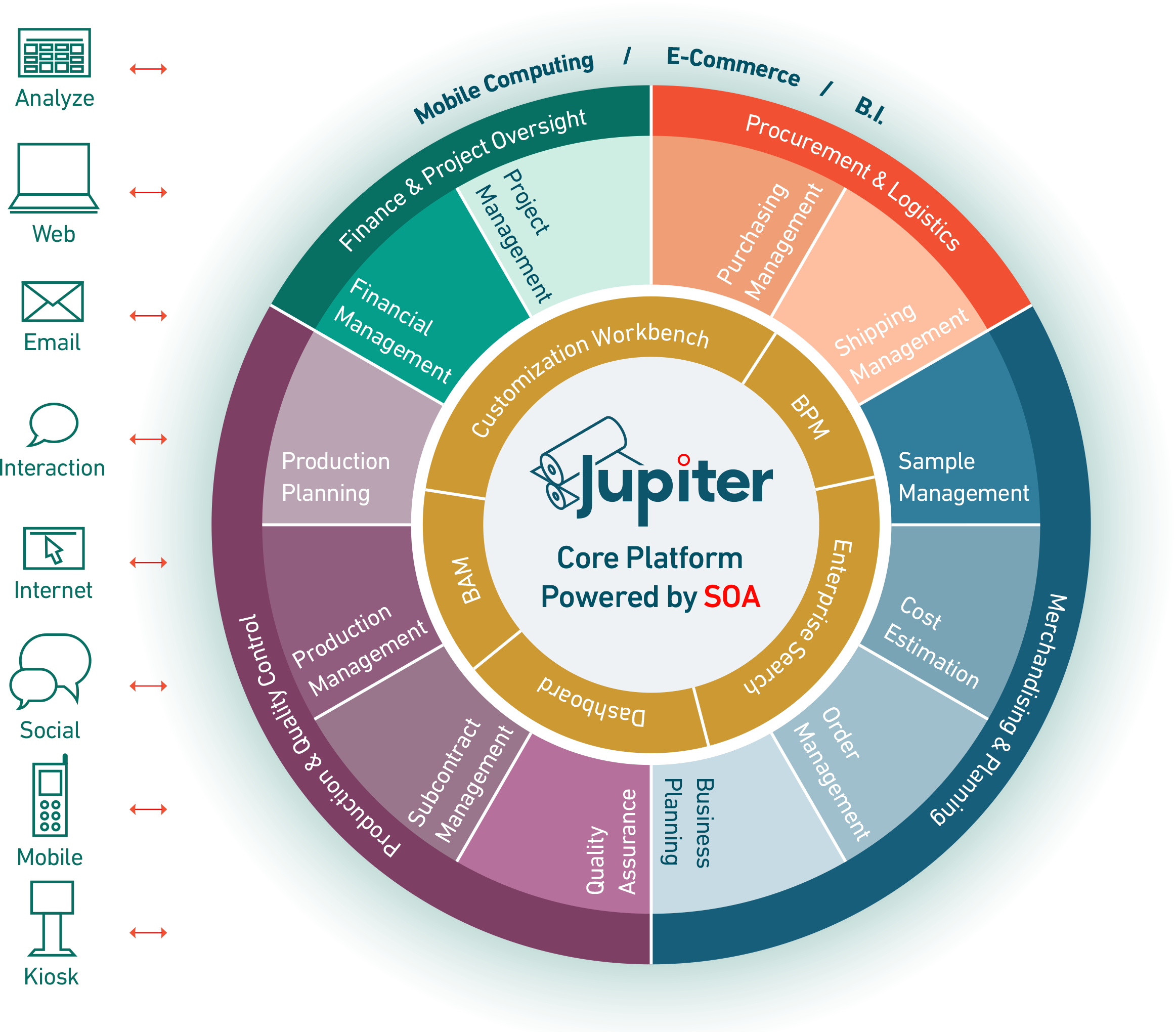
For printing and packaging manufacturers, Jupiter provides an Epicor-based solution designed around real print and packaging operations.
Jupiter aligns quote-to-delivery processes with how printing and packaging companies actually run — from estimating and order management through production planning, material control, shopfloor execution, quality control and delivery coordination.
Supporting cross-border manufacturing groups with unified systems, localized compliance, and centralized operational control.

Support multi-currency transactions, statutory financial reporting, tax compliance, and group-level consolidation.

Localized user interfaces and documentation for global teams and factory operations.

Adaptable to local accounting standards, e-invoicing mandates, and industry-specific regulations.

Headquarters-level visibility across subsidiaries with standardized data architecture.

Real-time synchronization of production, inventory, and supply chain data across factories.

Cross-border rollout expertise with regional support teams.
In today’s economic environment, ERP cost is no longer just an IT expense — it is a business decision.
If your company is paying high annual maintenance fees, support contracts, upgrade costs, customization fees or external consulting fees, it may be time to review whether the current ERP cost structure still makes sense.
Epicor + Jupiter gives printing and packaging manufacturers a more practical, industry-focused ERP path — with enterprise-level control and a more cost-effective operating model.
Epicor is a global ERP platform serving more than 23,000 customers across 150 countries, with more than 2.3 million daily users.
It has also been named a Leader in the 2025 Gartner® Magic Quadrant™ for Cloud ERP for Product-Centric Enterprises for the third consecutive year.
For manufacturers, this means Epicor is not just another ERP option — it is an established enterprise platform with global adoption, manufacturing focus and recognized market credibility.
A practical review should look beyond license or maintenance fees alone. It should include support cost, customization cost, upgrade cost, external consulting cost, internal IT effort, reporting workarounds, user productivity, and the cost of slow process changes.
If the total cost continues to rise while the business still needs heavy workarounds to operate efficiently, it may be time to compare the current ERP cost structure with a more focused Epicor + Jupiter alternative.
The key areas usually include annual maintenance, support contracts, customization and enhancement costs, upgrade projects, integration maintenance, reporting workarounds, external consultants, and internal IT resources required to keep the current environment running.
The objective is not only to compare software cost, but to understand the full cost of operating the ERP environment year after year.
Existing customizations should not simply be copied into the new system. They should be reviewed one by one to understand their business purpose, current usage and long-term value.
Some may be replaced by standard Epicor or Jupiter workflows. Some may be redesigned. Some may no longer be needed. This helps avoid carrying unnecessary complexity into the new ERP environment.
Data migration is not handled as a manual afterthought. Epicor provides data migration tools and import templates to support the transfer of business data into the Epicor environment, including Excel and CSV-based imports, with error logging to help identify and resolve import issues.
ACC combines these Epicor tools with a structured migration approach — reviewing what data needs to move, what should be cleaned or consolidated, and how key information such as customers, suppliers, items, BOMs, inventory, open orders, financial records and transaction history should be handled.
The objective is to create a clear data migration plan with mapping, validation and user review, so critical business data can move into the new system in a controlled and reliable way.
Most ERP environments connect with finance, warehouse, production, eCommerce, reporting, EDI, logistics or external platforms. These integrations should be reviewed early, not left until the end of the project.
ACC helps identify which integrations are business-critical, which can be simplified, and how they should be handled in the Epicor + Jupiter environment.
Yes. In many cases, a phased transition is the more practical approach.
ACC helps identify which areas should move first based on business priority, operational impact, data readiness and management objectives. This allows the company to start with the areas that create the most value, while keeping the overall transition more controlled and manageable.
The goal is not to recreate the same complexity in a new platform. ACC starts by reviewing business processes, customizations, data, integrations and reporting needs, then identifies where standard Epicor and Jupiter workflows can simplify the operating model.
This helps the new environment stay practical, maintainable and easier for users to adopt.
Jupiter is designed specifically for printing and packaging manufacturing. It supports industry workflows such as estimating, quotation, job order management, production planning, material control, shopfloor tracking, WIP visibility, quality control and delivery coordination.
This means printing and packaging manufacturers do not need to start from a completely generic ERP foundation and customize everything from scratch.
Jupiter includes printing and packaging-focused workflows and operational logic built around the way print and packaging manufacturers work. This helps reduce the need to force generic ERP processes into industry-specific operations through heavy customization.
The result is a more practical system design, easier adoption and lower long-term complexity.
If your annual ERP maintenance, support, customization, and upgrade costs keep rising, it may be time to review a more cost-effective path.
ACC can help you compare your current ERP cost structure with an Epicor + Jupiter model designed for printing and packaging manufacturing.
Tell us about your current ERP system, cost concerns, customization issues, or multi-site operation challenges.