Operational View
Explore the Core Modules Powering Your Digital Factory
Jupiter brings quoting, BOM, roll paper planning, and shopfloor execution into one platform. Each module is built for printing and packaging workflows and connects seamlessly to the next — from estimate to delivery.
Auto Paper Calculation, Print Costing, Post-Print Operations
Accurate, Fast, and Standardized
In printing and packaging, complex products and processes make quoting difficult — manual methods are slow, inconsistent, and error-prone. Jupiter provides a comprehensive quoting engine that automatically calculates paper, print, and post-press costs from materials, layout, and machine settings, with no manual entry required.
The system supports flexible pricing rules so you can customize coatings, wastage, and setup costs by process or method. When specifications change, costs and quotes update in real time, delivering accurate, clear, and consistent estimates for production control and cost calculation.
Whether you're estimating a new job or revising a quote, Jupiter helps you move faster and with full operational visibility.
Key Highlights
- Automatic paper costing — calculate paper usage and unit cost based on sheet size and waste rate
- Automatic printing cost calculation — compute print costs based on printing method and number of colors
- Post-press process costing — cover common post-press operations such as lamination, folding, and gluing
- One-click recalculation — support version changes and update cost and margin in real time
- Standardized quoting — minimize human error and inconsistency by reducing reliance on individual experience
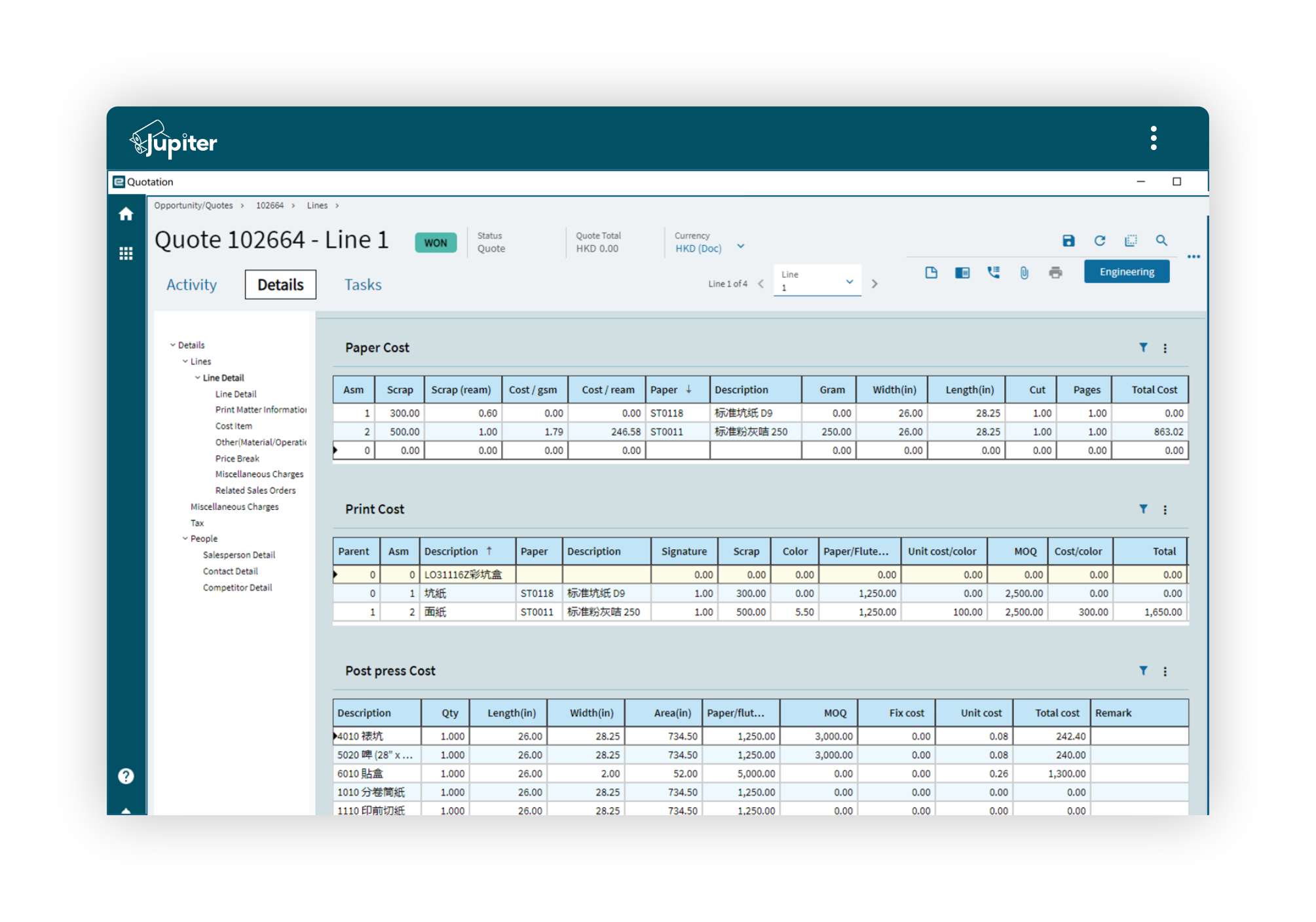
Key details such as paper size, print type, and quantity — users can quickly view and edit job info for accurate cost estimation.
Before, we had to consult estimators and juggle Excel. Now, with just one click, the entire job's cost is automatically calculated.
Packaging Templates, Fast Paper Calculation, Size Estimation
Smart Packaging Calculation to Boost Production Efficiency
In printing and packaging, choosing the right packaging layout and paper size is critical. Traditional methods are time-consuming and error-prone. Jupiter uses automation to help users quickly generate accurate layout and paper size plans, improving production efficiency and material planning.
Jupiter offers a range of standardized packaging templates. Users select product type and packaging style, and the system automatically recommends the best paper size and layout based on actual order specs — reducing manual error and improving estimation accuracy for cost calculation and operational visibility.
Key Highlights
- Packaging template selection — provide commonly used standard templates (e.g. double/twin pack, single pack) and support custom design and editing
- Fast paper size calculation — automatically calculate paper usage and quantity based on selected layout size and paper type for accurate matching
- Auto packaging size calculation — use packaging layout to auto-calculate packaging size and material usage, ensuring material sufficiency
- Real-time estimation — allow users to simulate packaging layout and paper usage in real time before actual planning
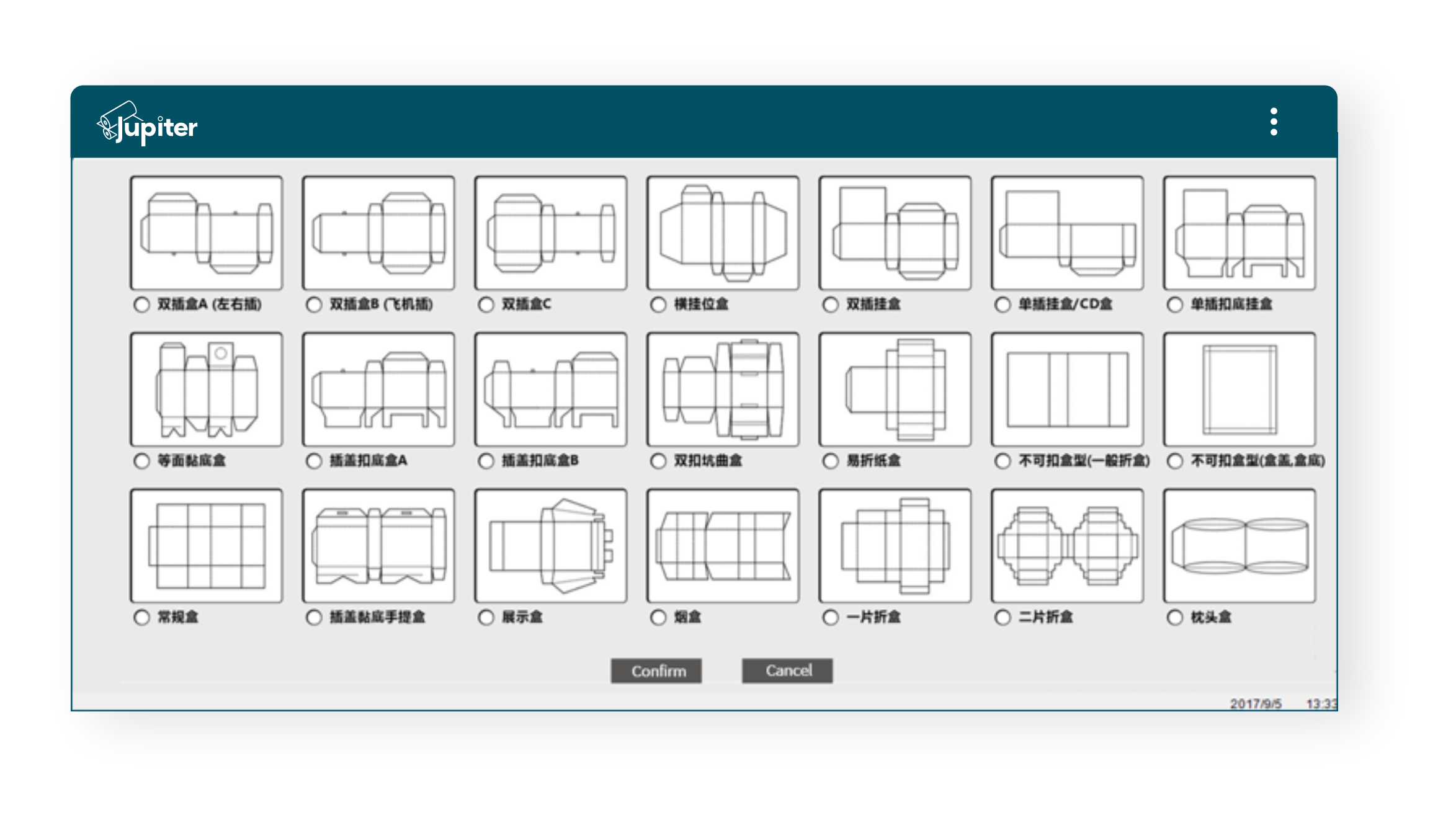
Automatically calculates paper size and quantity and provides real-time layout results to optimize material usage.
Now with one-click templates, paper size and layout are auto-calculated — much faster and more accurate!
Auto BOM Generation for Print Jobs
High-Efficiency BOM, Optimized Production Flow
In the printing and packaging industry, the Bill of Materials (BOM) and Bill of Operations (BOO) are critical for MRP and production scheduling. Traditionally, BOM and BOO setup required manual input — time-consuming and prone to error.
Jupiter provides auto-generation BOM so users can quickly generate BOMs based on different order types. It automatically calculates material and operation requirements, eliminates manual input, and ensures production planning accuracy. The auto-generated BOM is fully integrated with MRP and scheduling for dynamic alignment with different production scenarios and full operational visibility.
With BOM and BOO created automatically, planning accuracy and production flow efficiency improve dramatically.
Key Highlights
- Auto BOM generation — automatically generate BOM and production workflows based on customer printing needs and processes
- Material demand & production planning linkage — automatically align with MRP systems for accurate material demand planning
- Real-time data sync — automatically update BOM data to keep production and material information aligned
- Fewer errors, higher efficiency — auto-generate BOM and BOO to reduce manual input errors and ensure smooth production
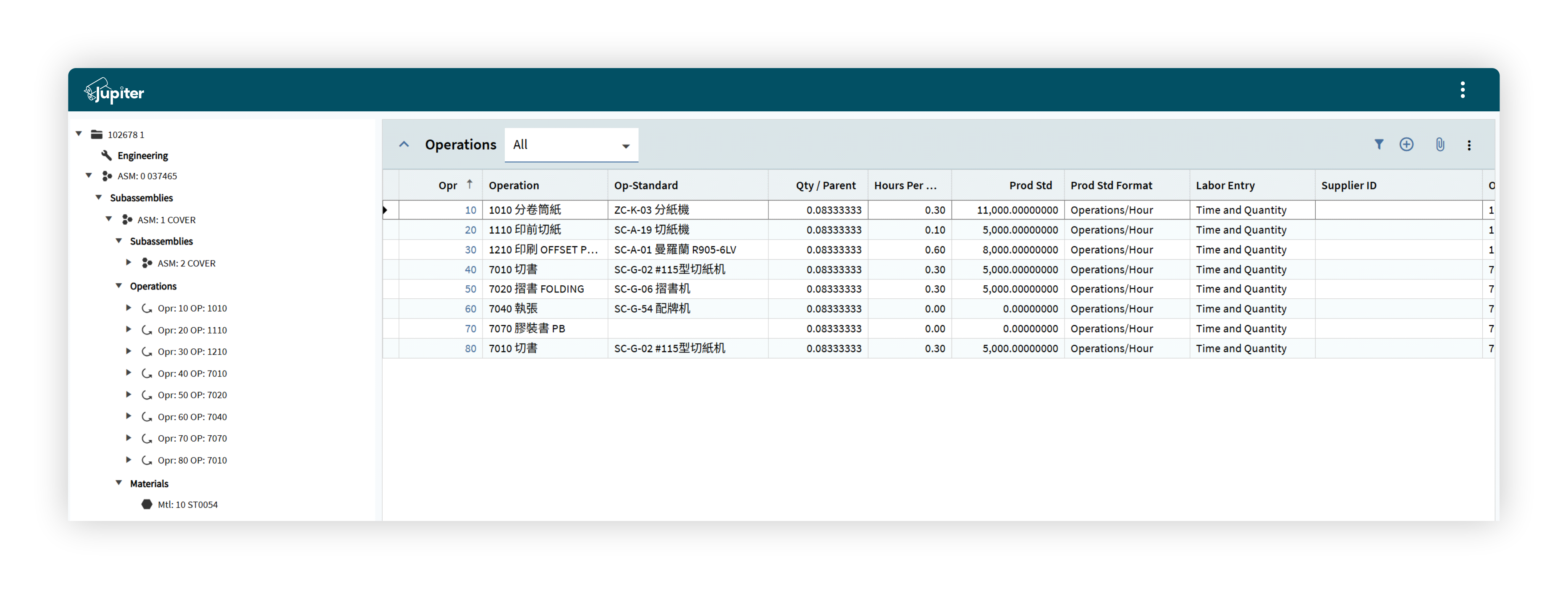
Automatically generates printing BOMs with standard time, quantity, and requirements for each production step.
We used to create BOMs manually — now it's all automated with one click, and efficiency has improved a lot!
Gang Printing for Multiple Jobs
Increase Production Efficiency, Optimize Printing Costs
In printing and packaging, multiple print jobs often share the same plate. Different job specs and schedules make coordination difficult — traditional imposition arrangement leads to challenges in scheduling and cost control, especially under tight deadlines or when combining different product types.
Jupiter simplifies this with smart grouping of compatible print jobs for imposition. The system automatically analyses product specifications and efficiently combines jobs on the same plate. The result is maximum material utilization, reduced waste, lower print costs, and less manual planning with improved production accuracy and operational visibility.
Key Highlights
- Flexible imposition grouping and scheduling — intelligently select and schedule print jobs by product requirements for optimized, streamlined production
- Auto-generated imposition work orders — automatically create combined print orders and schedules to reduce manual work and improve planning
- Improved efficiency — automate the scheduling process to reduce human error and increase production accuracy
- Labor and material savings — reduce manual workload and material waste across the production process
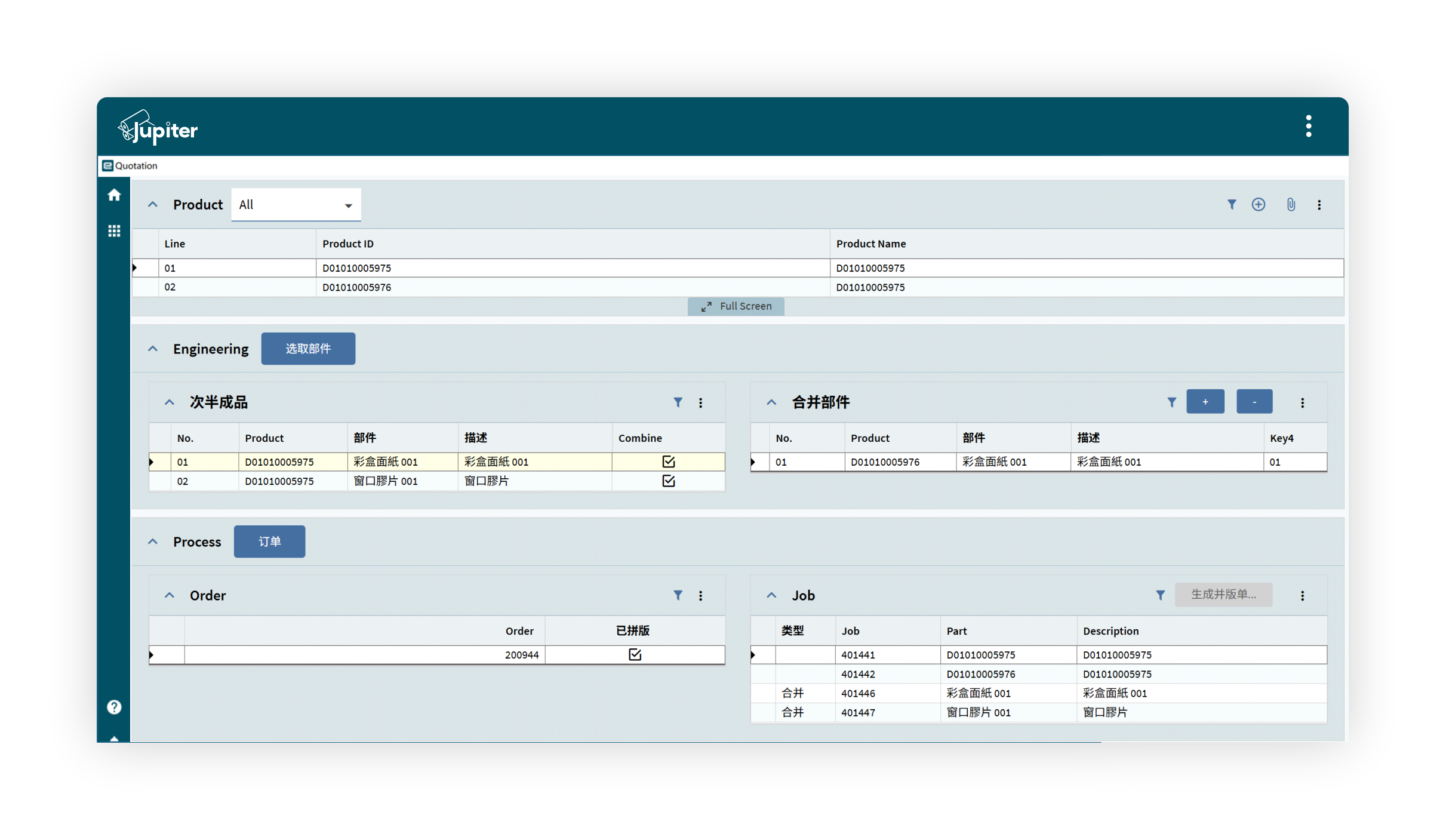
Jupiter simplifies imposition management and optimizes print layout combinations across multiple products.
With the Jupiter system, we can now combine multiple production jobs efficiently, ensuring optimal resource use and improved overall productivity.
Roll Paper Planning Workbench
Accurate Calculation, Quickly Generate Purchase Needs
In printing and packaging, roll paper demand is a key part of production. Every order and specification differs — the system must consider multiple variables, including size, thickness, and spec, to generate accurate purchase requirements for material planning and production control.
Jupiter uses structured data and smart algorithms to help businesses optimize roll paper demand planning. The result is improved procurement and production accuracy, smoother production, and full operational visibility. Real-time demand and inventory views support scheduling and allocation decisions so roll paper reaches the right operations on time.
Key Highlights
- Accurate roll paper demand calculation — automatically generate roll paper demand lists from production orders and inventory levels for alignment between procurement and production
- Smart purchasing plan — automatically calculate demand quantity, size, and delivery timing per roll paper for clear procurement guidance
- Multi-dimensional inventory management — track real-time inventory and demand forecasts to avoid over-purchasing or stockouts
- Integrated purchase order function — auto-generate purchase orders and sync to procurement for less manual entry and fewer errors
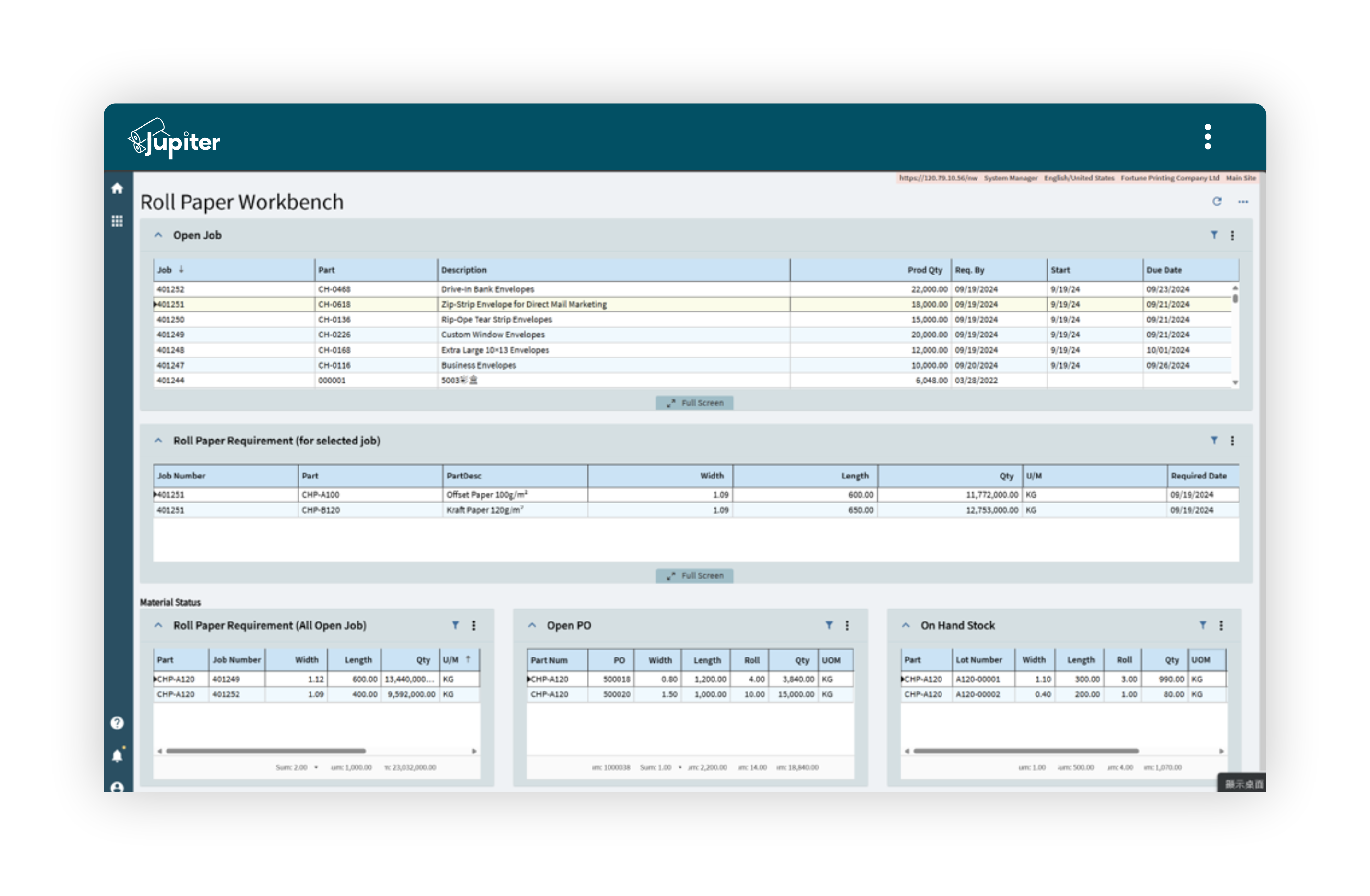
Work orders with roll paper demand, demand by work order, and roll paper inventory — helping planners act with clarity and speed.
Using Jupiter, we have significantly reduced roll paper waste and procurement delays — saving time and cost.
Pallet Tracking & Efficient Allocation
Full Visibility of Pallet Location and Flow
In printing and packaging, pallets are used across multiple production steps. Managing their location and flow is key to smooth operations and production control. Jupiter helps track pallet usage in real time and optimize allocation so materials are used accurately and delays or misplacement are avoided.
With smart tracking and allocation, Jupiter delivers full visibility of pallet status — improving efficiency, reducing waste, and supporting scheduling and material planning. The result is clearer operational visibility and better coordination across print and post-press operations.
Key Highlights
- Accurate pallet flow tracking — track each pallet batch via barcode and batch number for full visibility and to avoid loss or mix-up
- Flexible split and merge — split or merge batches according to production needs to keep the line running smoothly
- Cross-department merge support — enable pallet merging across departments for streamlined downstream processing
- Fast scan and operation — comprehensive scan workflows speed handling, reduce errors, and minimize delays
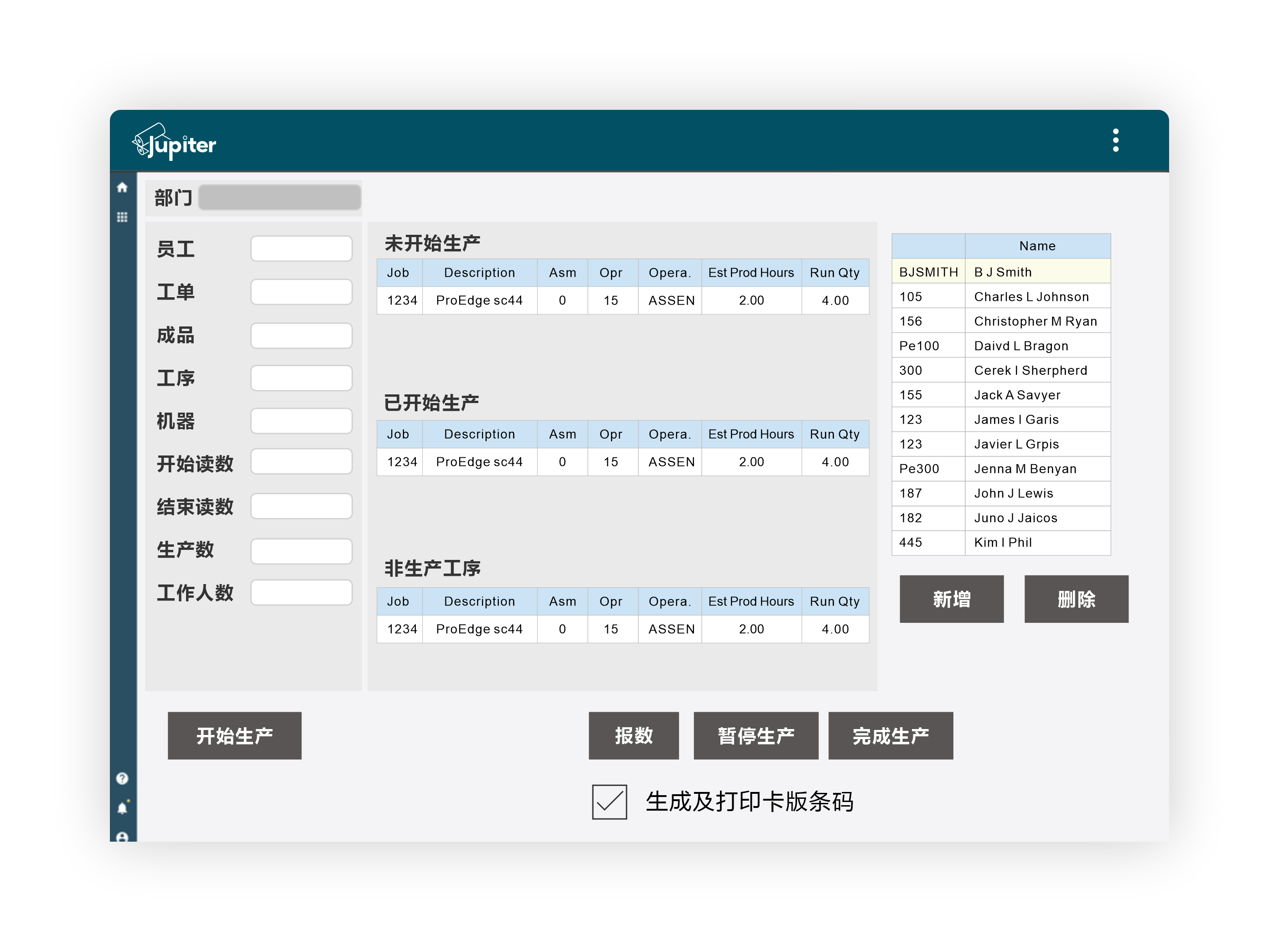
Via barcode and batch number, accurately track pallet flow in real time.
Jupiter makes pallet tracking and allocation much easier. It improves efficiency and keeps our processes in order.
Job Scheduling
Precise Scheduling Ensuring Efficient Production Flow
In modern printing and packaging, precise job scheduling is critical for smooth production and on-time delivery. Traditional manual scheduling struggles with complex production needs — poor coordination between planning and execution leads to delays and errors. As workload grows, manual scheduling becomes inefficient and lacks flexibility for sudden changes.
Jupiter uses advanced scheduling to prioritize production by actual demand and job urgency. The system enables precise job allocation and coordination, handles complex and urgent orders, and dynamically adjusts to changes so each workstation receives optimal production tasks. The result is improved visibility and accuracy of job scheduling, reduced lead time, and less resource waste for full operational visibility.
Whether for high-volume short runs or longer production plans, Jupiter keeps scheduling and allocation under control.
Key Highlights
- Multi-dimensional scheduling views — support day, week, and month views so users can visualize and manage production schedules effectively
- Real-time job tracking — track job progress in real time so managers can monitor each task and keep production flowing accurately
- Precise delivery coordination — integrate customer delivery schedules so the system auto-adjusts production to avoid early or late delivery and improve on-time performance
- Collaboration with external partners — support job collaboration with outsourced suppliers for cross-team coordination and progress tracking
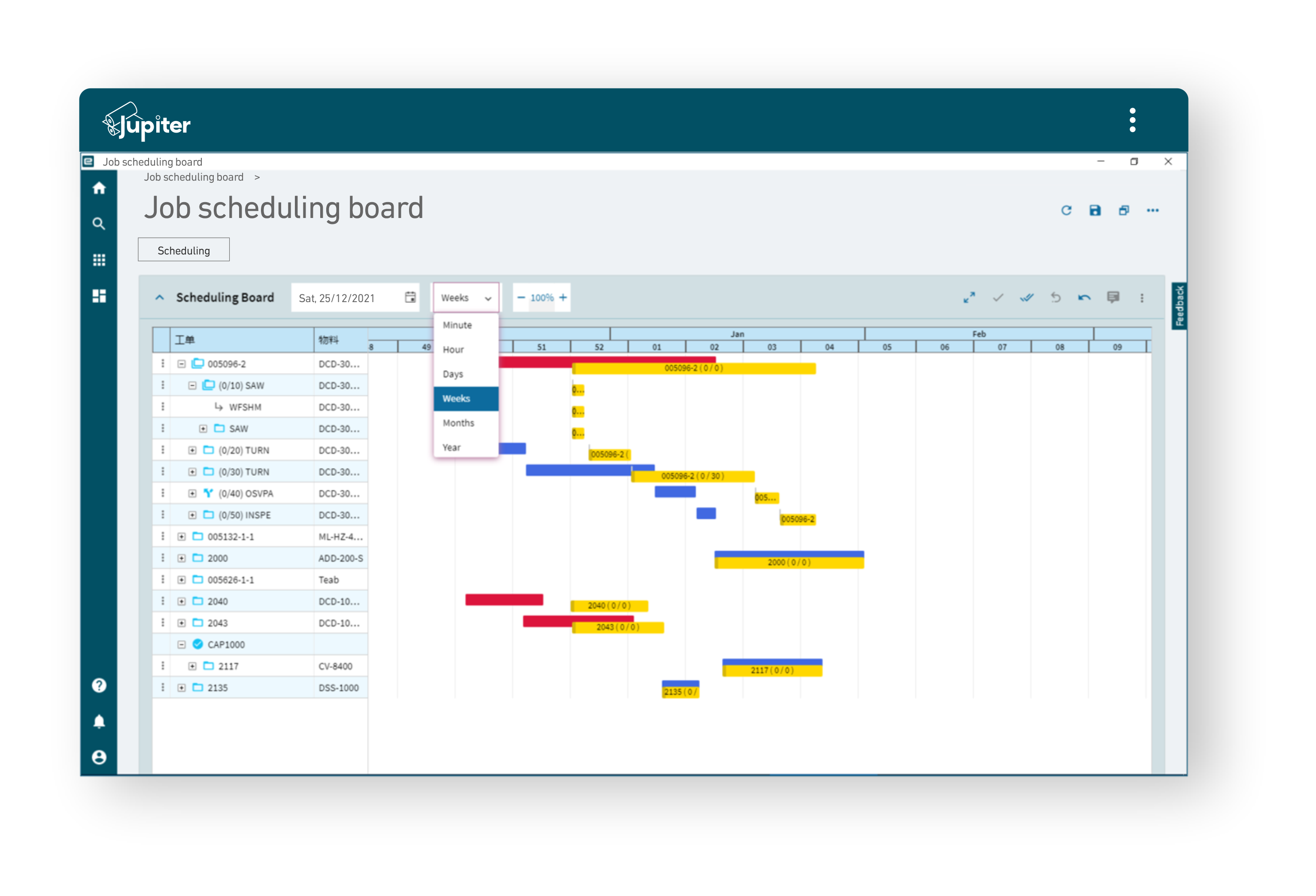
The job scheduling board supports multi-dimensional views, clearly showing the progress and status of each job.
We finally have one place to see every critical date and job. No more chasing spreadsheets.
Multi-Resource Scheduling
Real-Time Visibility into Equipment Scheduling
In printing and packaging plants, different production tasks must be assigned to various machines. Effective allocation of work and avoiding conflicts or idle time are essential for smooth production and minimizing resource waste.
Jupiter's Multi-Resource Scheduling Board is designed for the printing industry and supports complex task arrangements across multiple machines and operators. A visual drag-and-drop interface lets users flexibly manage job allocation for all machines — ensuring production plans run smoothly, optimizing resource utilization, and improving overall efficiency. Real-time operational visibility supports production control and scheduling and allocation decisions.
Whether you're coordinating print and laminate or balancing multiple presses, Jupiter keeps resource status clear and actionable.
Key Highlights
- Visualized equipment scheduling map — clearly show each press's work schedule and status so planners can see at a glance; supports multiple resources
- Synchronization scheduling — coordinate multiple resources (e.g. print + laminate) under a single task for smooth execution and no delays
- Real-time resource status display — show availability and status of all equipment and personnel for fast planning and adjustment
- Drag-and-drop task reordering — move tasks directly to adjust schedule order; simple and intuitive for quick response to changes
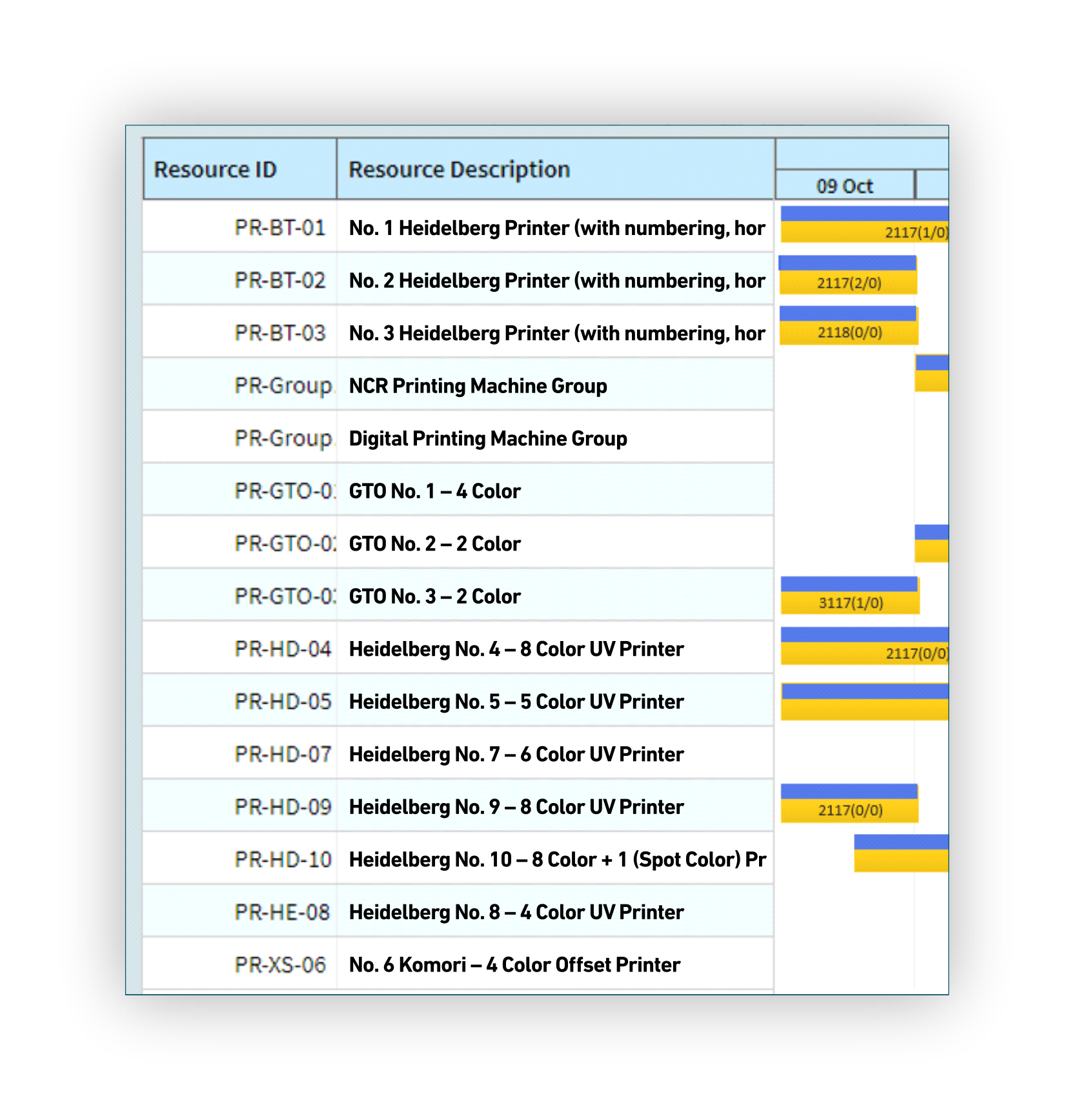
Visually displays each machine's task schedule to help planners allocate resources and time more efficiently.
We used to schedule dozens of printers manually in Excel. Now with Jupiter, machine assignments are clear and fast.
Complete Shop Floor Management
Real-Time Execution and Full Visibility
Jupiter provides a comprehensive work center management system to help printing and packaging companies digitize the entire production process. From work allocation and production scheduling to tracking and WIP, every process is connected in real time for full operational visibility and production control.
A user-friendly mobile interface lets floor supervisors and production staff access job data and monitor work status easily. The system generates and applies labels for each production batch based on work allocation, enabling full traceability. This connected workflow improves data accuracy, strengthens shopfloor execution, and supports timely delivery and better decisions.
Whether printing, laminating, or die-cutting, teams can monitor production status and workshop progress for timely planning and scheduling.
Key Highlights
- Quick job label generation — auto-generate job labels from job order, part, size, and color for full traceability
- Real-time progress updates — track work center production status with detailed reports and statistics
- Custom label printing — support custom label printing at each product stage for seamless traceability
- Barcode-based workflow binding — bind tasks, equipment, and process steps via barcode for smooth production flow and visibility
- Workshop scan reporting — workers scan to report work status for real-time progress tracking
- Visual work progress — graphical dashboards to track production progress and labor efficiency
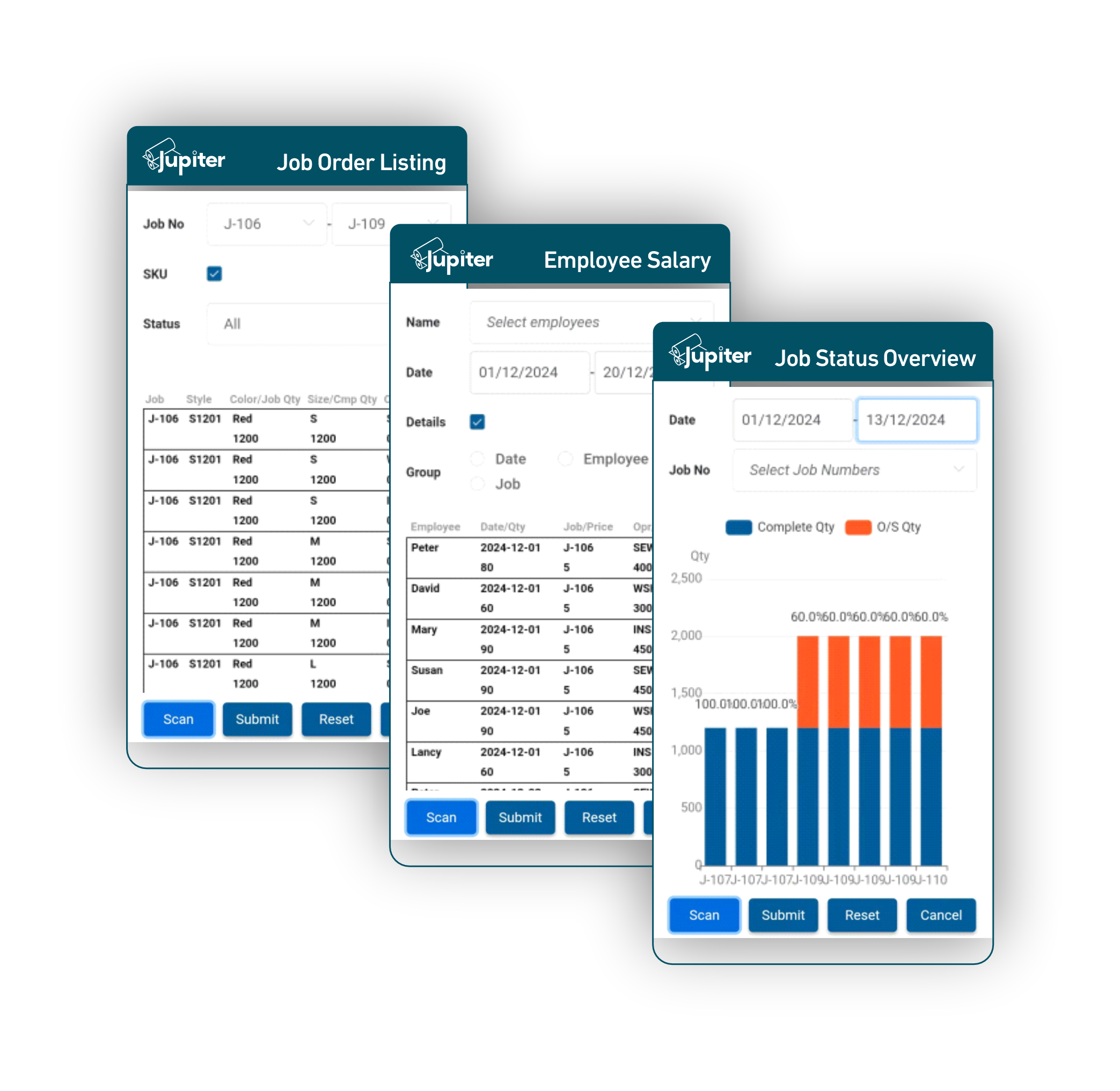
Workshop management and label generation — giving managers full visibility of job status and traceability at a glance.
We finally have one system for job tickets, labels, and progress — everything is connected and visible.